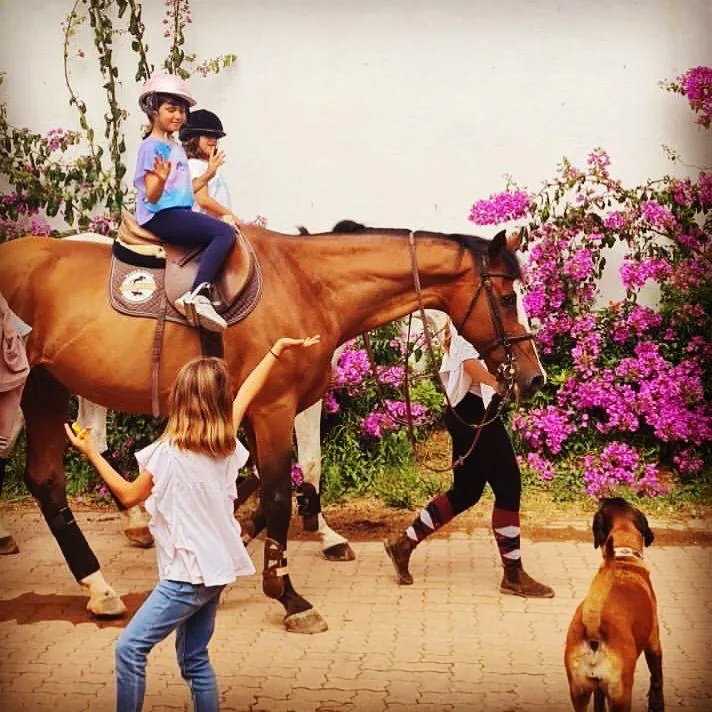
There is a familiar pattern to learning something new. You think about it over the summer, you tell yourself you will sort it out once life calms down, and then you file it under “January” — the month when everyone decides to change something.
If the thing you want to learn is horse riding, and you live anywhere between Lisbon and Cascais, January is close to the worst month you could pick. Autumn is the best one, and the reasons are practical rather than promotional.
This guide explains why the September–November window works so well at the Centro Hípico da Quinta da Marinha, and what a complete beginner — particularly someone who has recently moved to the Lisbon area — should actually do first.
Autumn weather on this coast is made for riding
The stretch of coast between Cascais and Guincho has its own microclimate, and it is kinder in autumn than most newcomers expect.
August here is hot and, near the coast, often windy in the afternoon. Riding in 34°C is uncomfortable for the rider and unfair on the horse, and a first lesson in that heat tells you almost nothing about whether you enjoy riding. By late September the temperature settles into the low twenties, the Atlantic wind drops, and the light holds well into the early evening.
November and December are wetter, but far milder than the northern European autumn most expats arrive from. The school runs all year, seven days a week, and heavy rain days are the exception rather than the rule.
If you start in January instead, your first three months of riding land in the coldest, darkest part of the Portuguese year. It is perfectly rideable — but it is a harder introduction, and first impressions matter more than they should.
September is when life here actually settles
For anyone who has recently relocated to Lisbon or Cascais, September is the month the temporary phase ends. The school year starts, work returns to its normal rhythm, and you finally know what your week genuinely looks like rather than what you assumed it would look like.
That matters more than it sounds. The most common reason a new rider stops after six weeks is not the riding — it is having chosen a lesson slot that never really fitted the week. Booking in autumn, once your routine is real, means picking a time you can actually keep.
There is a second, quieter advantage. Riding groups form at the start of the season, through September and October. In that window there is genuine flexibility to place a new rider with others at a similar level, rather than simply putting them wherever there happens to be a space. Riding alongside people at your own stage is one of the biggest factors in how fast you progress in your first year, and by midwinter the groups have largely stabilised.
Eight months is enough to become a rider
Start in October and you have roughly eight months of regular lessons before the following summer. That is enough time to move from “staying on” to riding with real independence — mounting, steering, sitting a trot without bracing, and beginning to canter with control.
Start in January and you reach the same summer with half that. The difference is not talent or aptitude. It is the calendar.
It also changes what summer looks like. Riders who begin in autumn arrive at the summer holiday season already competent enough to enjoy a long trail ride through the Sintra-Cascais Natural Park, rather than spending it still working through the basics in the arena.
Lessons are taught in English, Portuguese and French
This is usually the first question from anyone who has just moved here, and the answer is straightforward: lessons are taught in English, Portuguese and French.
For a beginner this is not a minor convenience. Early riding instruction is a stream of small, precise corrections — heels down, shoulders back, soften the inside rein, look where you are going. Those corrections have to land in the moment. If you are translating them, you are already a beat behind the horse, and you spend the lesson thinking rather than feeling.
Nor do you need any Portuguese to get started. Plenty of riders at the school are here on a two-year posting, and plenty of others have been in Cascais for a decade. Both work.
Instruction is with an instructor certified by the Federação Equestre Portuguesa since 1997 — the full background is here — which in practice means a consistent method rather than a rotating cast of teachers.
Getting to Quinta da Marinha from Lisbon
The school is at the Centro Hípico da Quinta da Marinha, Rua do Mirante, Casa 25 Pátio E, 2750-004 Cascais — between Cascais town and Guincho beach, on the edge of the Sintra-Cascais Natural Park.
By car from central Lisbon: roughly 35–40 minutes via the A5, outside rush hour. From Cascais itself, under ten minutes. There is parking on site.
By train: the Cascais line from Cais do Sodré runs along the coast and takes about 40 minutes to Cascais station. From there it is a short taxi or rideshare to Quinta da Marinha — the last stretch is not comfortably walkable.
From Sintra, Estoril or Carcavelos: all within a 10–25 minute drive.
If you are weighing up a weekly commitment from Lisbon, be honest about the journey rather than optimistic. A Saturday morning or a mid-morning weekday slot is a far easier habit to keep than a weekday rush-hour lesson.
What to book first
The most common mistake is deciding everything at once — monthly plan, full kit, two lessons a week. It is unnecessary and it usually backfires.
First, book a single lesson. It is the honest way to find out whether riding suits you. A beginner taster lesson (30 minutes) is €40. A standard single lesson of about an hour is €60. A private one-hour lesson is €80.
Then confirm the slot that genuinely works — using your real autumn week, not a theoretical one.
Only then move to a monthly plan:
- Once a week: €140/month
- Twice a week: €240/month
- Three times a week: €340/month
- One-off registration fee (monthly plans): €150
If your schedule is irregular — frequent travel, shifting work weeks — the 12-lesson card at €600, valid for six months, is the more sensible option. It offers less consistent progress than a fixed weekly slot, but it beats missing half of a monthly plan. All prices exclude VAT; the full price list has the current detail.
Leave equipment until last. A helmet and the essential kit are provided for early lessons. Buying your own gear before you know whether you are going to stick with it is the fastest way to spend money you did not need to spend.
Full details of formats and levels are on the horse riding lessons page.
What the first few weeks are really like
It is worth calibrating expectations, because almost everyone finds the first lessons surprising.
The first two or three lessons are mostly walk. Position, balance, learning to communicate with the horse. If you were expecting to canter on day one, it can feel slow — but this is the part that determines how good a rider you become.
Muscles you did not know about will ache. Inner thighs, core, lower back. It settles after three or four lessons.
Progress is not linear. Some weeks everything clicks and some weeks feel like going backwards. That is the normal pattern for any motor skill, riding included.
Once a week is enough to start. What does not work is the alternative pattern — three lessons one month, none the next. Riding is a physical skill, and skills consolidate through regular, spaced repetition. Consistency beats volume.
Frequently asked questions
Is autumn a deadline? Can I still start in December? Yes, you can start any time — the school runs all year. Autumn is the ideal window, not a cut-off. Starting later simply means less flexibility on group placement and less of the season remaining.
Do I need to speak Portuguese? No. Lessons are taught in English, Portuguese and French, and beginners regularly ride here with no Portuguese at all.
Does riding continue through the winter? Yes, seven days a week, 08:00 to 20:00. There are adjustments on days of heavy rain, but winter on this coast is considerably milder than most new arrivals expect.
Am I too old to start? Almost certainly not. A significant share of beginner riders here are adults starting in their thirties, forties and fifties. Adults typically learn the theory faster than children and take a little longer to relax physically — both entirely manageable.
Do I need to be fit before I start? No. The relevant fitness is built by riding. What helps most at the beginning is not strength but a willingness to relax on the horse.
What is the minimum age for children? Structured group lessons generally start from around 6–7 years old. Below that there are different introductory formats with a different pace and duration.
Can I try one lesson before committing to anything? Yes, and it is what we always recommend. A single lesson answers more questions than any amount of research.
Next step
If learning to ride has been on your list since you arrived, the practical difference this year is small: book a lesson in September or October instead of promising yourself January.
→ Get in touch to book a first lesson this autumn → See the full price list → Read about the riding lessons