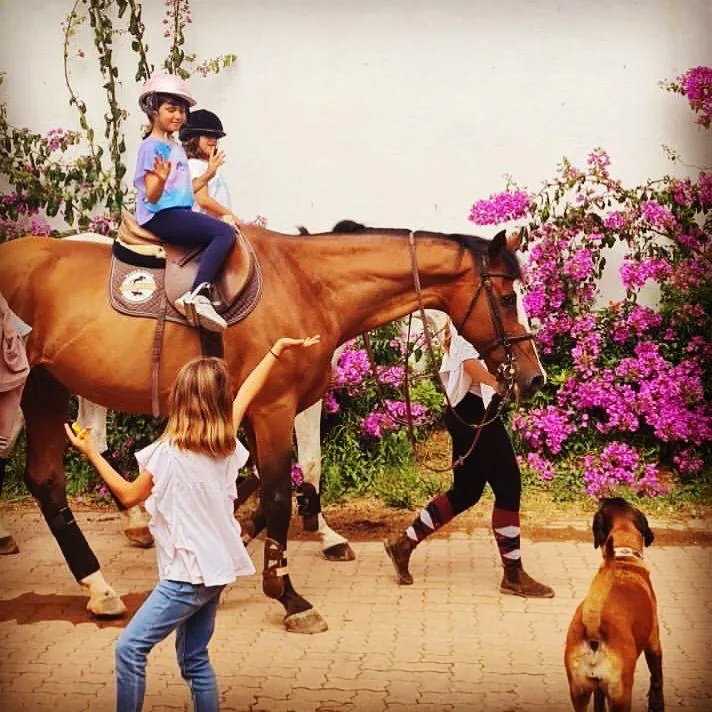
Riders who come to us at the Centro Hípico da Quinta da Marinha in Cascais often arrive with the same honest complaint after their first few lessons: they are far more tired than they expected. An hour in the saddle leaves their thighs shaking, their lower back aching and their breathing heavier than a gym session would.
That is normal, and it is not a sign of poor general fitness. Plenty of runners and cyclists find their first rising trot humbling. Riding asks for a specific combination of qualities — stability without stiffness, strength held for long periods rather than used in bursts, and balance on a surface that keeps moving.
The good news is that these qualities respond quickly to a small amount of focused work. This article covers what rider fitness actually means, which areas matter most, and a realistic plan for the days you are not riding.
Why riding feels harder than it looks
From the side of the arena, a competent rider looks like they are sitting still. That stillness is the illusion. What is really happening is a continuous series of small corrections, made with the core, hips and legs, to stay in balance with an animal that is accelerating, decelerating and bending underneath you.
Three features make it demanding in an unusual way:
It is isometric work. Much of what your body does in the saddle is hold a position against movement, rather than produce movement. Isometric work fatigues muscles that rarely get trained that way — the deep abdominals, the adductors on the inside of the thigh, the muscles that stabilise the shoulder blade.
It is asymmetrical. Almost everyone is stronger and more mobile on one side. On a horse, your asymmetry becomes the horse’s problem: you sit heavier on one seat bone, your horse drifts, and your instructor asks you to straighten up for the fourth time.
It is unpredictable. A horse does not move on a fixed rhythm the way a rowing machine does. Your body has to react, which means balance and proprioception matter as much as strength.
The ridden side of all this — where your seat bones sit, how your leg hangs, when to follow the movement — belongs in a lesson, and is what riding lessons spend most of their time on. The off-horse work below is what makes those corrections possible to hold.
The five areas worth training
1. Core stability
“Core” has become a vague word. For riders it means something specific: the ability to keep your ribcage stacked over your pelvis while your arms and legs work independently.
The test is not how many sit-ups you can do. It is whether your lower back stays neutral when your legs move. Riders who lack this stability compensate by gripping with the knee or bracing against the reins — both of which an instructor will spend lessons trying to undo.
Exercises that transfer well:
- Dead bug — lying on your back, opposite arm and leg lowering slowly while your lower back stays flat to the floor. 8–10 slow reps each side.
- Plank with movement — a standard forearm plank, then tapping one foot out to the side without letting your hips rotate. 30–45 seconds.
- Bird dog — on hands and knees, extending opposite arm and leg. Slow, with a pause at the top.
2. Hip mobility
A long, relaxed leg with the thigh rotated slightly inward is what allows you to sit deep and use your leg aids clearly. Tight hips force the knee up and the heel out, and no amount of instruction fixes a joint that simply does not open that far.
Most adults who sit at a desk have restricted hip extension and internal rotation. This is one of the areas where a few minutes a day makes a visible difference within a month.
Exercises that transfer well:
- Half-kneeling hip flexor stretch — back knee down, pelvis tucked under, holding 45 seconds each side.
- 90/90 hip rotations — seated on the floor, rotating both knees from one side to the other.
- Deep squat hold — feet flat, holding for 30–60 seconds, using a doorframe for support if needed.
3. Single-leg strength
In rising trot, light seat and jumping position, your weight goes through your legs — and rarely evenly. Double-leg exercises like the back squat hide imbalances. Single-leg work exposes and corrects them.
Exercises that transfer well:
- Split squats — 8–10 each leg, controlled, knee tracking over the foot.
- Step-ups onto a low box or a stair, with no push off the back foot.
- Single-leg glute bridges — important for the hip extension that lets you absorb canter.
4. Balance and proprioception
Balance is trainable, and it is the quality that most directly reduces the feeling of being a passenger. The aim is to be able to recover from a small loss of position without clutching at the reins.
Exercises that transfer well:
- Single-leg stance, eyes closed, 30 seconds each side. Harder than it sounds.
- Tandem walking — heel to toe along a line, slowly, looking ahead rather than down.
- Wobble cushion or folded towel work, standing on one leg while passing an object from hand to hand.
5. Aerobic endurance
A quiet dressage lesson is moderate exercise. A jumping lesson, a cross-country school or a two-hour trail ride along the Guincho coast is considerably more, and riders who are out of breath lose precision before they lose strength.
You do not need to become a runner. Two or three sessions a week of 20–30 minutes of brisk walking, cycling, swimming or hill walking is enough for recreational riding. If you ride for longer periods — our trail rides run up to two hours — build towards something closer to the duration you ride for.
A realistic weekly plan
Most riders we teach have one or two lessons a week and ordinary working lives. This plan assumes that, and takes about 20 minutes a session.
| Day | Focus |
|---|---|
| Monday | Mobility: hips, ankles, thoracic spine (15 min) |
| Tuesday | Riding lesson |
| Wednesday | Strength: single-leg work plus core (20 min) |
| Thursday | Aerobic: 25–30 min brisk walk, swim or ride |
| Friday | Mobility plus balance work (15 min) |
| Saturday | Riding lesson or trail ride |
| Sunday | Rest, or an easy walk |
Three points matter more than the exact layout:
Do not do heavy leg work the day before a lesson. Tired legs grip, and gripping undoes technique. Put strength work on the day after riding where you can.
Consistency beats volume. Fifteen minutes four times a week does more for your riding than ninety minutes once a fortnight.
Progress slowly if you are returning after a break. Riders coming back to the sport in their forties and fifties improve just as well as anyone else, but the first six weeks should feel too easy rather than too hard.
What off-horse training will not fix
Fitness is a foundation, not a substitute. There are things only saddle time and instruction give you:
- Timing of the aids — knowing precisely when in the stride to ask.
- Feel — recognising from the saddle that the horse is behind your leg or falling in.
- Confidence — which comes from repeated, well-managed experience with a horse, not from the gym.
A rider who is fit but rides once a month will progress more slowly than a rider of modest fitness who rides weekly. If you have to choose, choose the lessons. Our group plans start at €140/month for once a week, €240/month for twice and €340/month for three times, with a one-off €150 registration fee on monthly plans. A 12-lesson card at €600, valid six months, suits irregular schedules, and single lessons are €60, or €80 private. All prices exclude VAT.
Frequently asked questions
How fit do I need to be to start riding? Fit enough to walk up a flight of stairs without difficulty. Beginner lessons are 30 minutes at walk and trot, and the fitness builds from there. Nobody is turned away for being unfit.
Will going to the gym improve my riding? Some of it will. Single-leg strength, core stability and mobility transfer directly. Heavy bilateral lifting and bulk-focused training transfer very little, and very tight, overworked legs can actively get in the way.
Why do my inner thighs ache so much after a lesson? Because the adductors work isometrically to stabilise your leg, and most activities never ask that of them. It settles within a few weeks of regular riding. If you are also gripping out of nervousness, it takes longer — mention it to your instructor, who can give you exercises in the lesson to help.
Is riding itself good exercise? Yes, though it is usually moderate rather than vigorous for recreational riders. It builds postural strength and balance well, and is less useful as cardiovascular training unless you are doing longer or faster work.
I am over fifty and out of condition. Is it too late? No. Adults starting or returning in their fifties and sixties are a normal part of any riding school. The sensible approach is more frequent, shorter sessions and a slower build.
Do I need to speak Portuguese for lessons? No. Lessons at Miguel Alves Horses are taught in English, Portuguese and French. Most of our international riders are taught entirely in English.
Next step
The most useful thing fitness work does is let you spend your lesson thinking about riding rather than about how tired you are. Start with the mobility and core work — those two make the biggest difference in the first month — and keep the lessons regular.
If you are near Lisbon and want an instructor to assess where you are, Miguel Alves has been a FEP-certified instructor since 1997 and teaches at the Centro Hípico da Quinta da Marinha in Cascais, seven days a week from 08:00 to 20:00.
→ Get in touch to book a lesson → See riding lessons in detail → See the full price list