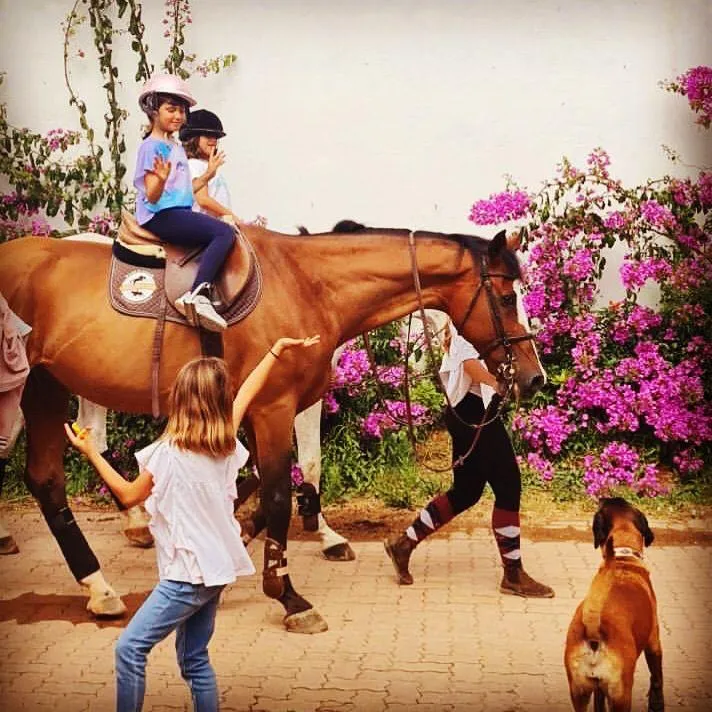
Most people who ride at a school never feed a horse. The hay is already in the stable, the bucket has already been made up, and the horse you are about to ride has been managed by someone else since six in the morning.
So why should a rider care how horses eat?
Because almost everything you notice about a horse under saddle has a feeding story behind it. A horse that is sluggish on Monday and sharp on Thursday. A horse that cannot settle in the arena an hour after its bucket. A horse that is off work for a fortnight because of colic. Riders who understand the basics ask better questions, notice problems earlier, and make far fewer mistakes the first time they are handed a horse of their own to look after.
We teach at the Centro Hípico da Quinta da Marinha in Cascais, where school horses and privately owned horses live side by side. This is the explanation we give riders who ask what is in the bucket and why — and it is deliberately practical rather than technical.
The single most important idea: forage first
A horse is a trickle feeder. In the wild it grazes for sixteen to eighteen hours a day, taking in small amounts of fibrous grass almost continuously. Its digestive system is built around that pattern and does not adapt well when the pattern is broken.
Two consequences follow, and they explain most of modern feeding practice.
The stomach is small and never switches off. A horse’s stomach holds roughly 8 to 15 litres — tiny for a 500 kg animal — and it produces acid continuously, whether or not there is food in it. An empty stomach is an acidic stomach, which is why long gaps between meals are associated with gastric ulcers.
The hindgut does the real work. Fibre is fermented by microbes in the caecum and large colon. That microbial population is specialised and slow to change, so sudden shifts in diet leave the wrong bugs in charge and the gut disturbed.
Everything else in this article is a footnote to one sentence: forage — hay, haylage or grass — is the foundation of the diet, and hard feed is the adjustment on top.
How much forage
The working rule of thumb is that a horse should eat at least 1.5% of its body weight in forage per day on a dry matter basis, and ideally closer to 2%. For a 500 kg horse that is roughly 7.5 to 10 kg of hay a day.
Note how much that is. A generous haynet looks like a lot to a newcomer and is often less than half a day’s ration.
So what is grain for?
Hard feed — concentrates, grain, “the bucket” — exists to cover the gap between what forage provides and what the horse’s workload demands. For a great many horses, including a lot of school horses, that gap is small.
A horse in light work on decent hay may need little more than a balancer: a small, nutrient-dense feed that supplies vitamins, minerals and quality protein without adding meaningful calories. A horse competing, growing, recovering from illness or struggling to hold weight needs more.
The common error is to treat hard feed as the measure of good care. An overfed, under-exercised horse on a big bucket of cereals is not a well-kept horse. It is a horse at higher risk of excitability, laminitis, ulcers and hindgut upset.
Reading the bucket
Most yards in Portugal use some combination of the following.
Cereals and compound mixes. Energy-dense, grain-based, traditional. Useful for hard-working horses, easy to overdo.
Fibre-based cubes and chaff. Slower-releasing energy, closer in behaviour to forage, increasingly the default for leisure and school horses.
Beet pulp and soaked feeds. Soaked fibre, good for older horses and for getting water into a horse that drinks poorly. Always soaked properly before feeding.
Oil. Dense calories with no starch, often added for condition and coat.
Balancers and supplements. Vitamins, minerals, electrolytes, joint support. Genuinely useful when they fill a known gap; largely a waste of money when they do not.
Feeding and ridden work
This is the part that matters most to riders, because it concerns the hours around your lesson.
Do not work a horse hard immediately after a large hard feed. The conventional allowance is around one to three hours between a substantial concentrate meal and intense work. Digestion diverts blood to the gut, a full stomach presses on the diaphragm, and the combination is neither comfortable nor efficient.
Forage before work is a different matter. A small amount of hay or chaff before exercise is actively helpful: it forms a fibrous mat in the stomach that reduces acid splashing onto the unprotected upper stomach wall during fast work. Riding a horse on a completely empty stomach is the thing to avoid.
Let a hot horse cool before its bucket. Walk it off, let the breathing settle, let it drink. Then feed.
Small and often beats large and rare. Two or three modest hard feeds a day are easier on the system than one big one, which is why yards with staff on site through the day tend to split rations.
If you ride once or twice a week at a school, none of this is your responsibility — but it does explain why the yard asks you not to give the horse treats before a lesson, and why the horse you are riding may already have had hay at seven in the morning.
Water, salt and the Cascais climate
Water is the nutrient people forget. A horse at rest drinks roughly 20 to 50 litres a day, and considerably more in heat or after work. Dehydration is one of the most common contributors to impaction colic.
On this stretch of coast the practical issues are seasonal. Summer here is hot and dry, and a horse working in July sweats heavily — losing not just water but sodium, chloride and potassium, which is why salt or electrolytes matter in the warm months. Winter brings the opposite problem: horses drink less when water is cold, which is the moment impaction risk rises.
What this means for you as a rider is simple. Offer water after work, and never discourage a horse from drinking because you are in a hurry to untack.
The feeding mistakes that actually cause problems
Most feeding disasters come from a short list.
Changing feed abruptly. Introduce any new feed or new hay over seven to fourteen days, mixing increasing proportions. The hindgut microbes need the transition time.
Too much starch at once. Large cereal meals overwhelm small-intestine digestion, push starch into the hindgut and ferment where they should not. If a horse needs a lot of hard feed, it needs it split across several meals.
Long gaps without forage. A horse with nothing to eat from eight in the evening until seven the next morning is a horse with eleven hours of acid on an empty stomach.
Feeding by the scoop rather than by weight. A scoop of one feed can weigh twice as much as a scoop of another. Yards that weigh feed know what they are giving.
Treats from strangers. This is the one that involves riders directly. A handful of something unexpected matters less for the calories than for the colic risk, the allergy risk and the habit of nipping it teaches. Ask before you give a horse anything.
Feeding grass clippings. Never. Lawn clippings ferment rapidly and are a well-documented cause of serious colic and laminitis.
Condition: the skill worth learning
The most useful feeding skill is not arithmetic, it is observation. Learn to look at a horse and judge its condition — ribs easily felt but not seen, no hard fat pads on the crest, shoulder or tailhead, a topline built of muscle rather than fat.
Weigh tapes and body condition scoring charts help, but the habit matters more than the tool. Ask your instructor to show you on the horse you ride most often. Once you can see condition, you can see change, and change is what tells you something needs attention.
Frequently asked questions
What do horses eat? Predominantly forage — grass, hay or haylage — which should make up the large majority of the diet by weight. Hard feed such as cubes, mixes, chaff or a balancer is added on top to cover what forage does not supply for the horse’s workload, along with fresh water and access to salt.
How much does a horse eat each day? As a guide, at least 1.5% of body weight in forage per day on a dry matter basis, so roughly 7.5 to 10 kg of hay for a 500 kg horse, plus whatever hard feed its work requires.
How long after feeding can you ride a horse? Allow roughly one to three hours after a substantial hard feed before intense work. A small amount of forage shortly before riding is beneficial rather than harmful.
Can I give the school horse a carrot or an apple? Ask the yard first. Most schools allow it at specific moments and not others, and some horses are on restricted diets for medical reasons. At our yard the usual answer is yes, after the lesson, from a flat palm — but always check.
Why do horses get colic from feeding mistakes? Because the hindgut depends on a stable microbial population digesting fibre. Sudden diet changes, large starch meals and insufficient water disrupt that balance or slow gut movement, and the result can be anything from mild discomfort to a surgical emergency.
Do horses need supplements? Only where there is a gap to fill. A forage-based diet with an appropriate balancer covers most leisure horses. Electrolytes in hot weather and specific supplements recommended by a vet are the sensible exceptions.
Who feeds the horses at a riding school? Yard staff, on a fixed daily routine. If you board a horse rather than riding school horses, the feeding arrangement is one of the things your boarding agreement should set out in detail.
Next step
You do not need to master equine nutrition to ride well. But knowing that forage comes first, that hard feed is an adjustment rather than a measure of generosity, and that sudden change is the enemy will put you ahead of most riders at your level — and it will make you much safer the day you have a horse of your own to feed.
If you ride with us at Quinta da Marinha and want to understand the horse you are riding beyond the hour in the arena, ask. We teach in English, Portuguese and French, Miguel Alves has been a FEP-certified instructor since 1997, and the yard is open seven days a week from 08:00 to 20:00.
→ See our riding lessons → Boarding, where feeding and daily care are included → See the full price list → Get in touch to arrange a first lesson or a visit