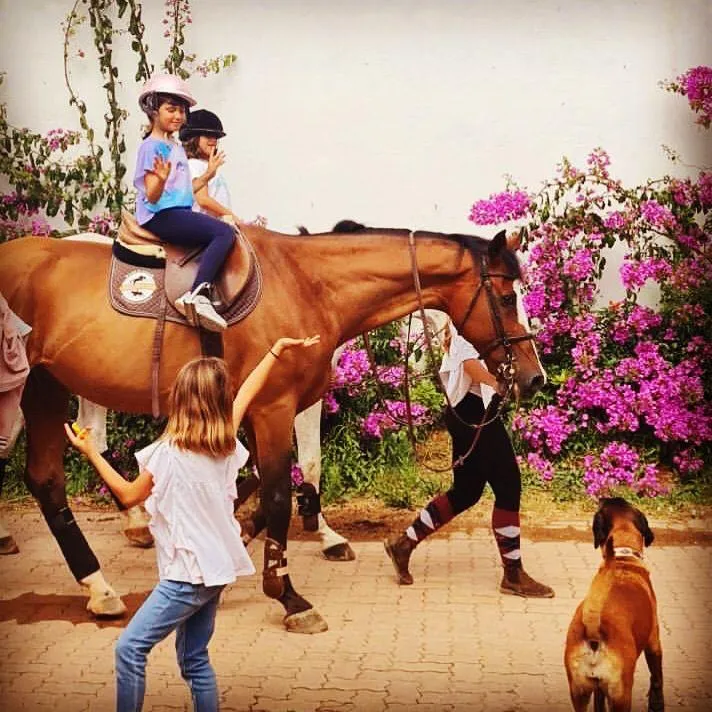
If you have moved to Portugal with a horse, or bought one after settling here, you quickly discover that the hard decision is not which horse to ride. It is where the horse lives.
A riding school you dislike costs you an hour a week. A boarding yard you dislike costs your horse twenty-three hours a day, every day, and moving a horse is disruptive enough that most owners endure a bad fit far longer than they should.
We board horses at the Centro Hípico da Quinta da Marinha in Cascais, and we also talk to a steady stream of owners who are visiting yards for the first time — often newly arrived, often unsure what the normal standard is in Portugal and what should raise an eyebrow. This article is the list of questions we would ask if we were in their position, and what a straight answer to each one sounds like.
Bring the list. Ask it out loud. A yard worth boarding at will not mind being interviewed.
1. How much turnout does my horse actually get, and in what weather?
This is the question that separates yards more than any other, and the one most often answered vaguely.
“Turnout is available” is not an answer. The answers you want are numbers: how many hours per day, how many days per week, alone or in a group, and what happens when it rains for a week — which, on this coast, it does in January.
Horses are built to move more or less continuously. A horse stabled twenty-four hours a day with one ridden hour is a horse at higher risk of colic, stiffness, box walking and weaving. Some horses tolerate restriction well; many do not, and you cannot tell in advance which yours is.
A good answer sounds like: daily paddock turnout as standard, with named exceptions (injury, extreme weather, ground damage), and a visible paddock you can walk out to.
2. Who is on site, when, and what happens at 2am?
Ask who sleeps on the property, or how quickly someone can be there. Then ask what happened the last time a horse colicked overnight.
The second question is the useful one. Every working yard has had an emergency; how they describe handling it tells you more than any policy statement. You are listening for a clear chain: who noticed, who was called, which vet came, how the owner was informed.
Also ask about weekend and holiday cover. Yards that run smoothly on a Tuesday sometimes thin out dramatically on 25 December.
A good answer sounds like: continuous on-site presence, a named emergency vet, and a specific recent story told without defensiveness.
3. What exactly is in my horse’s feed, and who decides it?
Feed is where boarding agreements get quietly expensive and quietly inconsistent.
Find out what forage is fed, how many times a day, and whether hay is weighed or fed ad lib. Then find out who controls the hard feed: the yard on a standard ration, or you, by instruction. If your horse needs a specific balancer, a low-starch feed or a supplement, ask whether that is included, charged separately, or simply not possible.
Ask one more thing: who physically does the feeding. A ration decided by a nutritionist but mixed by whoever happens to be around on Sunday is not the same ration.
A good answer sounds like: a written feeding programme, consistent forage, and a clear rule about who may change it.
4. How are the boxes built, cleaned and ventilated?
Walk into the stable block and use your nose before your eyes. Ammonia you can smell at head height means bedding is not being managed, and the horse breathing it is standing with its nostrils much closer to the floor than yours.
Look for box size appropriate to the horse’s height, solid safe partitions, no protruding ironwork, and genuine airflow — windows or openings, not just a corridor. Ask how often boxes are fully stripped rather than skipped out.
Horses are also social animals. Boxes where a horse can see and touch neighbours are generally better for behaviour than isolated ones.
5. Which vet and farrier come here, and how often?
There is a real difference between a yard that holds your horse while your own vet visits and a yard that has professionals coming regularly on a schedule.
Regular on-site visits make routine care — vaccinations, dental checks, shoeing cycles — far less likely to slip, which matters enormously if you travel or work long hours. Ask for the names, ask how often they come, and ask whether you may still use your own vet if you prefer. The answer to that last question should be yes.
Our Full Board clients get weekly visits from the partner vet and farrier, with written reports sent to the owner — the arrangement is described in full on the horse boarding page.
6. What can I use, and when?
Facilities on a tour and facilities in practice are different things.
Ask specifically: which arenas can boarders use, at what hours, and what gets priority. A yard that also runs a busy lesson programme or a competition yard may have the indoor school booked at exactly the times you finish work. That is not necessarily a problem — but you want to know before you sign, not in February when it is dark at six.
Check the surfaces too. An outdoor arena that floods, or a sand surface that goes hard in summer without watering, limits your riding more than a slightly smaller one that is properly maintained.
7. What is the real monthly cost, including the things nobody mentions?
Ask for the headline price, then ask what is not in it.
The common extras are bedding beyond a standard allowance, specific feeds and supplements, worming, routine farriery, vet call-outs, holding fees for vet visits, clipping, rug washing, and turnout rug changes. None of these is unreasonable to charge for. All of them are unreasonable to discover later.
For reference, our boarding plans run from €500/month for the Rider plan (box, feed, daily cleaning and fresh water), €600/month for Half Board (adding grooming, supervised exercise and full arena access), to €1,250/month for Full Board with personalised daily care and regular owner reports. All prices exclude VAT and are billed monthly — the complete list, alongside lesson pricing, is on the prices page.
Compare on total annual cost, not on headline rate.
8. What does the contract say about notice, liability and insurance?
Read it, and read it before the yard visit becomes an emotional decision.
The clauses that matter: notice period on both sides, what happens to prepaid months if you leave, who is liable for injury to your horse and injury caused by your horse, whether third-party liability insurance is required of you, and whether the yard may make veterinary decisions in your absence and up to what cost.
That last one is worth settling calmly in advance. The alternative is settling it by phone, at night, while someone waits for an answer.
9. Can I talk to the owners who already board here?
The best source of information about a yard is the people paying for it.
Ask to speak to two or three current boarders — not testimonials selected for a website, but people you meet in the aisle. A yard with nothing to hide will shrug and point you at whoever is tacking up.
Ask them the practical things: does the invoice match what was quoted, do messages get answered, has anything gone wrong and how was it handled, would they move if something closer came up.
10. Does this yard suit the horse I actually have?
The final question is the one that cannot be answered by the yard.
A fit competition horse, a retired veteran, a sharp young horse and a cob that gains weight looking at grass all want different things. Ample grass turnout is excellent for one and a laminitis risk for another. A busy yard with constant activity suits a confident horse and overwhelms an anxious one.
Decide what your horse needs before you start comparing yards, then judge each one against that list rather than against a general idea of quality. The best yard in the region may still be the wrong yard for your horse.
A note for owners new to Portugal
Two practical points come up repeatedly with international owners.
Paperwork follows the horse. A horse living in Portugal needs its identification document and vaccination record in order, and a yard should be comfortable telling you what it expects to see. If you imported the horse, keep the import documentation with the passport.
Language is rarely the obstacle people fear. Yards in the Lisbon and Cascais area deal with international owners routinely. At Miguel Alves Horses we work in English, Portuguese and French, and most of our international clients communicate entirely in English.
Frequently asked questions
How much does it cost to board a horse near Lisbon? Full-service boarding in the Cascais and Lisbon area typically runs from around €500 a month for a basic box-and-feed arrangement to €1,200 or more for full care with grooming, exercise and managed veterinary and farrier visits. Our own plans are €500, €600 and €1,250 per month, excluding VAT.
What is the difference between part livery, half board and full board? Terminology varies between yards, which is exactly why you should ask for the task list rather than the label. Broadly, the cheaper tiers cover box, bedding, feed and water, while higher tiers add grooming, exercising, rug changes and co-ordination of vet and farrier care.
Should I visit a yard more than once before deciding? Yes, and ideally at different times — once on a tour and once unannounced at a busy hour, such as morning feeding. The second visit is far more informative than the first.
Can I keep my horse at a yard and also take lessons there? Usually yes, and it is a sensible combination: your instructor sees the horse daily and knows how it has been going. We teach boarders alongside school riders at Quinta da Marinha.
How much notice do I need to give to move my horse? Commonly one calendar month, but it varies and it is a contract term worth checking before you sign rather than after.
Is boarding availability a problem in Cascais? It can be. Good yards in this area tend to run close to full, so spaces come up irregularly. If you are planning a move, start enquiring a couple of months ahead.
Next step
Choosing a yard well is mostly a matter of asking unglamorous questions and listening carefully to how they are answered. A yard that gives you numbers, names and specifics is telling you it keeps records. A yard that gives you adjectives is telling you something too.
If you are looking at options around Lisbon and Cascais, boarding at the Centro Hípico da Quinta da Marinha is worth a visit — we recommend seeing any yard in person before deciding, including ours. Miguel Alves has been a FEP-certified instructor since 1997, and the yard is open seven days a week from 08:00 to 20:00.
→ Get in touch to check availability and arrange a visit → See boarding plans in detail → See the full price list